
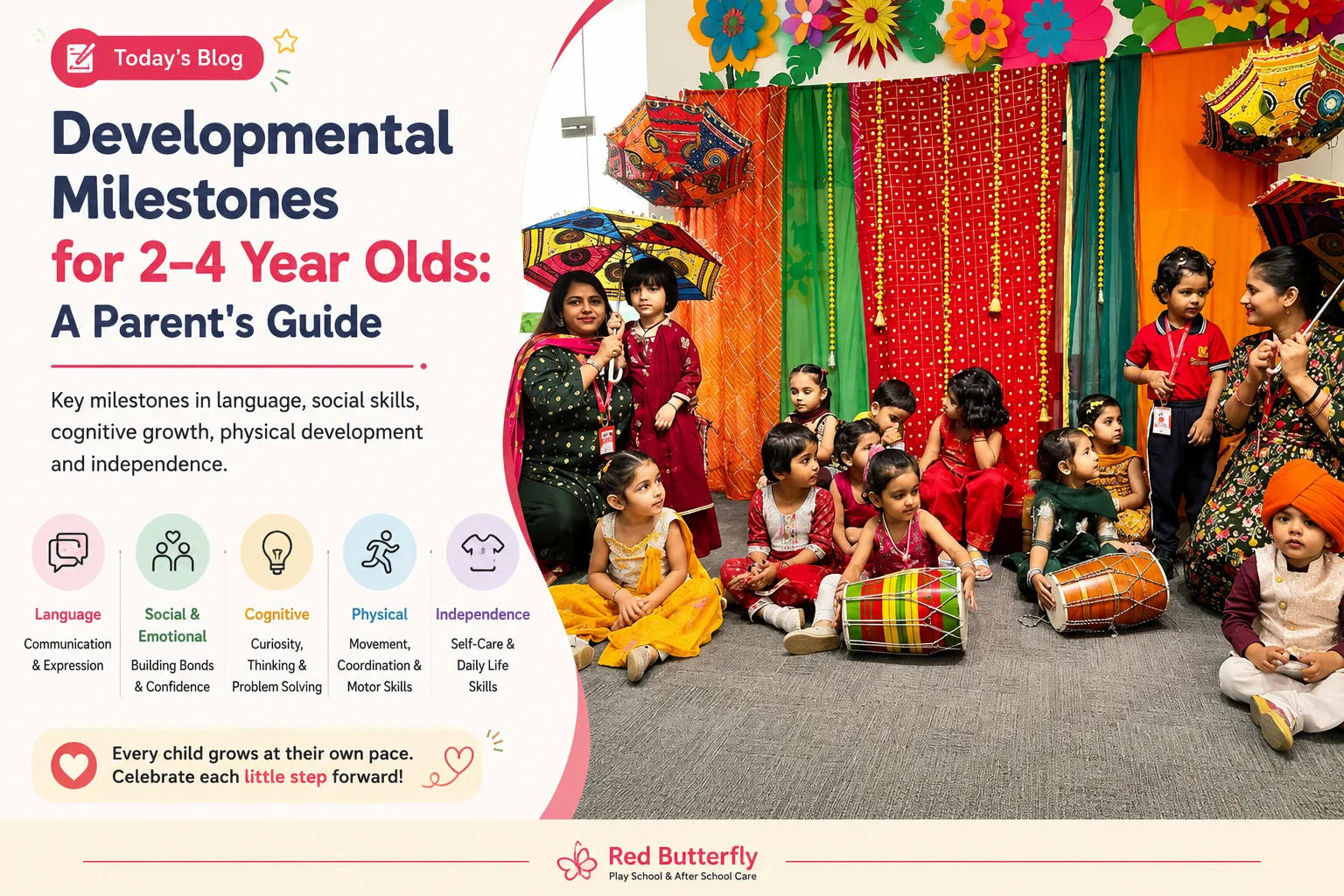
Between the ages of two and four, children move through an extraordinary period of growth — language expands rapidly, social awareness deepens, physical coordination improves noticeably, and independence begins to take real shape. For parents, understanding what typically happens during this window can offer helpful context, while also providing reassurance that the wide range of "normal" development is exactly that: a range, not a fixed schedule every child must follow identically. This guide walks through general developmental milestones across this age band, organised by area.
An Important Note Before Reading Further
Developmental milestones are general guidelines based on population-level research, not strict individual benchmarks. Children develop at genuinely different paces, and a wide range of variation within these general windows is entirely normal. This article is intended for general informational purposes; if you have specific concerns about your child's development, a conversation with your paediatrician remains the most reliable next step.
Language Development
Around age 2: most children can use short two-to-three-word phrases, understand simple instructions, and have a vocabulary of roughly 50 or more recognisable words. Around age 3: many children begin forming more complete sentences of four to five words, ask simple questions, and can be understood by familiar adults most of the time. Around age 4: sentences typically become more complex and grammatically structured, and children can often tell simple stories or describe recent events.
Social & Emotional Development
Around age 2: parallel play — playing alongside other children without much direct interaction — is common and developmentally typical. Around age 3: children generally begin engaging in more cooperative, interactive play with peers, showing early interest in sharing and taking turns. Around age 4: more sustained cooperative play and simple friendships typically develop, along with growing empathy and an increasing capacity to manage frustration.
Cognitive & Physical Development
Around age 2: simple problem-solving emerges, alongside beginning pretend play and basic sorting or matching by colour or shape. Around age 3: pretend and imaginative play typically becomes more elaborate, and curiosity-driven questioning ("why?") often increases noticeably. Around age 4: children generally engage in more complex imaginative and role play, and begin understanding basic cause-and-effect reasoning. Physically, most 2-year-olds can run with reasonable coordination and climb stairs with support; by age 3, many can pedal a tricycle and jump with both feet; by age 4, gross motor skills typically become more refined, including hopping and catching a ball.
Independence & Self-Care
Around age 2: many children begin showing interest in self-feeding and simple dressing tasks, though still requiring considerable adult assistance, and toilet training readiness signs may begin to emerge. Around age 3: growing independence in dressing, self-feeding, and hand-washing is common. Around age 4: many children can dress and undress with minimal assistance and follow simple multi-step routines with growing reliability.
What to Do If You Have Concerns
If your child appears to be significantly behind typical developmental patterns in a specific area, it is always worth raising this directly with your paediatrician, who can properly assess your child's individual development and recommend any appropriate next steps. At the same time, it is worth resisting the temptation to compare your child too closely against other specific children of the same age — the range of typical development within this age band is genuinely wide.
How This Shapes Classroom Support
Understanding this general developmental range is part of why a strong preschool classroom does not expect uniform progress from every child of the same chronological age. At Red Butterfly Play School & Day Care, teachers observe each child individually across language, social, cognitive, physical, and independence-related development, adjusting support and encouragement accordingly. A teacher-to-child ratio of approximately 2:15 in the Pre-Nursery and Nursery classrooms supports this individualised observation directly.
Frequently Asked Questions
My child seems behind peers in speech but ahead physically — should I be concerned?
Uneven development across different areas is common and generally not a cause for concern on its own. If speech delay is significant or persistent, discussing it with your paediatrician is a reasonable next step.
Is it normal for toilet training readiness to vary so much between children?
Yes, toilet training readiness varies enormously between individual children and is not strongly tied to overall intelligence or general development.
How can preschool support my child's development across these areas?
A well-structured, play-based preschool programme naturally supports language, social, cognitive, physical, and independence-related development through daily activities, structured play, and consistent teacher observation.
A Wide, Normal Range of Growth
The years between two and four are marked by rapid, uneven, and genuinely individual development across every area of a child's growth. A patient, observant, individually responsive approach — both at home and in a well-run preschool classroom — supports every child best, regardless of their specific pace. Parents in Sector 89, Hayatpur, and the surrounding Gurugram community are welcome to discuss their child's individual development directly with the Red Butterfly teaching team.
This article is intended for general informational purposes and is not a substitute for professional developmental assessment. If you have specific concerns about your child's development, please consult your paediatrician.