
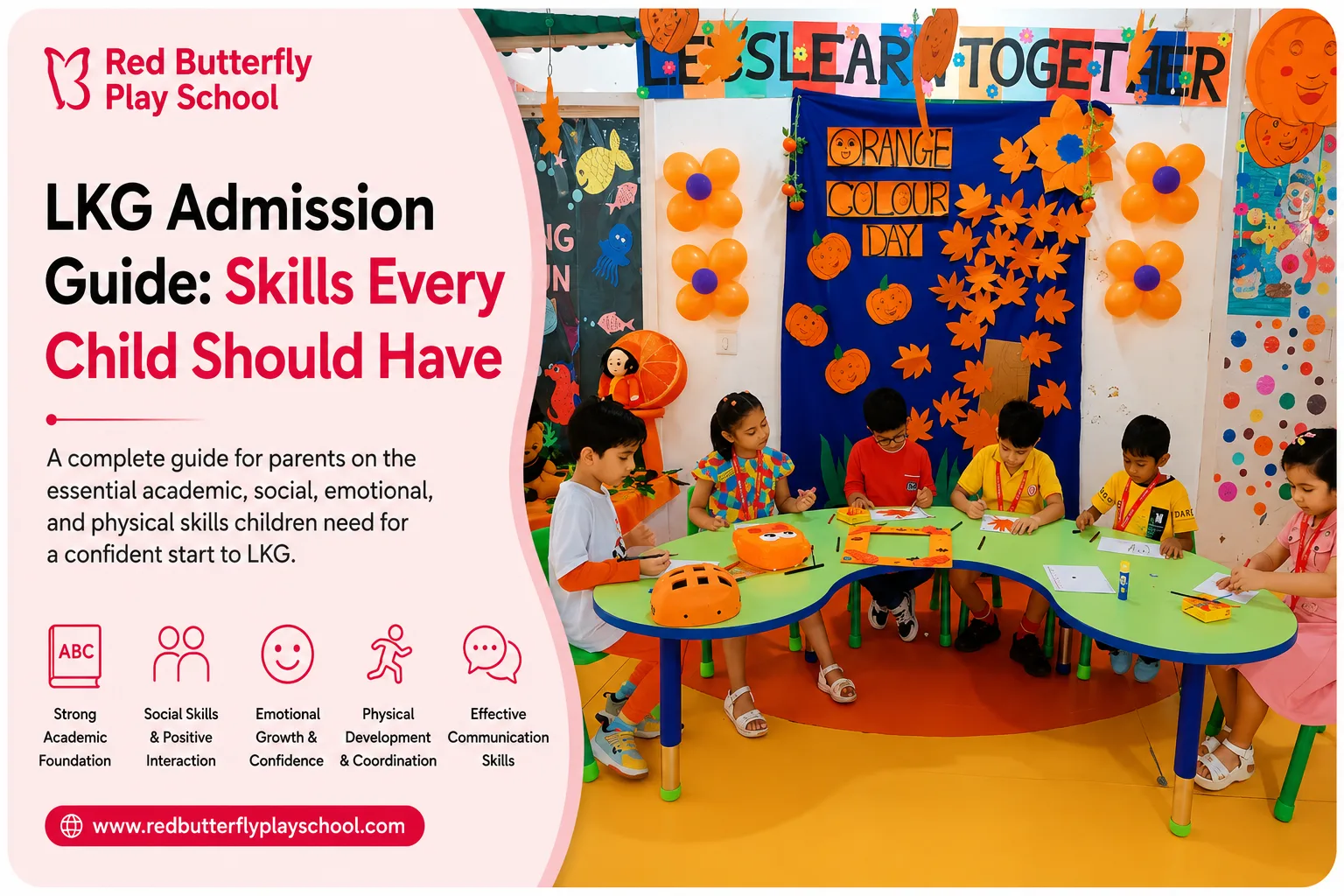
LKG, or Lower Kindergarten, occupies an interesting position in a child's early education journey — far enough along that some genuine academic expectations begin to apply, yet still firmly rooted in the play-based approach that defines the years before formal schooling. For parents preparing to enrol a child in LKG, or whose child is already partway through Nursery, this guide explains what LKG typically expects developmentally, and how to approach the transition with clarity rather than pressure.
What Makes LKG a Distinct Stage
LKG sits between Nursery and UKG, and represents a meaningful step up in structure. Where Nursery introduces early literacy and numeracy gently, largely through play, LKG typically expects a child to engage with these concepts somewhat more consistently — while still delivering nearly all of this content through activity-based, hands-on methods rather than formal seated instruction. Socially and behaviourally, LKG classrooms generally expect a slightly higher degree of group cooperation, sustained attention, and independent task completion compared to Nursery.
Typical Age Eligibility for LKG
Most CBSE-aligned schools, including those following NEP 2020's framework, generally expect a child to be around 4 years old for LKG, calculated as of the region's specific cut-off date — March 31 in North India, including Gurugram. At Red Butterfly Play School & Day Care, LKG is designed for children roughly between 3.8 and 4.8 years of age, in line with this regional convention, with some flexibility considered for children whose birthdays fall close to the cut-off.
Academic Skills Typically Expected by the End of LKG
- Letter and sound recognition. Recognising uppercase and lowercase letters (A–Z, a–z) and identifying their corresponding phonics sounds, laying the groundwork for reading.
- Early reading. Reading simple sight words and short, familiar sentences, typically introduced through phonics-based instruction and repeated exposure to picture books and stories.
- Basic writing. Writing letters and numbers with reasonable control, and beginning to form simple words independently.
- Number sense. Counting confidently, recognising numbers into the double or triple digits, and understanding basic concepts such as more/less, before/after, and simple patterns.
Social, Emotional, Physical & Communication Skills
Socially, LKG children are generally expected to share and cooperate within group activities, follow classroom rules with growing consistency, and build simple friendships beyond the smaller, caregiver-dependent interactions typical of Nursery. Emotionally, this includes expressing feelings using words, managing transitions between activities, and beginning to show empathy toward classmates. Physically, a steadier pencil grip and improved cutting and colouring precision are typical, alongside reasonable balance and stamina for outdoor play. Communication-wise, most children speak in relatively complete sentences, follow two-to-three-step instructions, and grow more confident participating in circle time and show-and-tell.
What If My Child Isn't Meeting Every Benchmark?
It bears repeating clearly: these are general developmental benchmarks, not a strict checklist a child must fully satisfy before LKG can begin. Children develop unevenly across different skill areas, and a certain range of variation is entirely typical. A skilled LKG teacher is well-equipped to work with children across a normal range of starting points. If a child is joining LKG without prior Nursery experience, this is also manageable — most preschools, including Red Butterfly, are experienced in helping children adjust and catch up gradually within a supportive classroom environment.
The LKG Admission Process
The LKG admission process generally mirrors other early-years admission stages: an initial enquiry, a school tour, a brief informal interaction between the child and the admissions team (not an academic test), submission of standard documentation such as the child's birth certificate and parents' identification, and a final discussion of fee structure. Parents are encouraged to begin this process a few months ahead of the intended start date, particularly in high-demand corridors such as Sector 89. Our step-by-step admissions guide covers the full process end to end.
How Red Butterfly Structures LKG
At Red Butterfly Play School & Day Care in NBCC Heights, Sector 89, the LKG programme builds these academic, social, emotional, physical, and communication skills through a structured but still largely play-based curriculum — phonics activities, number games, storytelling, art and craft, music and dance, outdoor sports, and structured fine motor activities such as threading and puzzle work. Classes maintain a teacher-to-child ratio of approximately 2:20, allowing teachers to closely observe and support individual progress.
Frequently Asked Questions
What is the main difference between LKG and Nursery?
LKG introduces somewhat more consistent academic content — particularly phonics, early reading, and number recognition — while still relying heavily on play-based and activity-based teaching methods, building on the foundation established during Nursery.
Will my child start reading and writing in LKG?
Most children begin recognising letter sounds, reading simple sight words, and writing basic letters and numbers during LKG, though the pace varies from child to child and continues to develop through UKG.
Do LKG classrooms assign homework?
Homework practices vary by school. Parents are encouraged to confirm specific homework expectations directly with the school.
What if my child seems shy or hesitant in group settings during LKG?
This is common and generally improves gradually with consistent exposure to group activities and a patient, supportive teaching approach — it is rarely a cause for significant concern at this stage.
Approaching LKG With Confidence, Not Pressure
LKG represents a meaningful step forward, but it should not feel like a high-stakes academic hurdle. With a curriculum that balances genuine academic progress against continued play, social development, and emotional support, most children move through this stage building real confidence, one activity at a time. Parents in Sector 89, Hayatpur, and the surrounding Gurugram community are welcome to discuss LKG admission directly with the Red Butterfly team.