Anyone researching preschools in Gurugram today will quickly notice that the market is dominated by large, national franchise chains — brands with hundreds or even thousands of branches across the country, backed by considerable marketing budgets and standardised curricula. Alongside these chains, however, sit a smaller number of independent, locally owned and operated preschools. For parents in Sector 89 and the surrounding Gurugram corridor, understanding the real differences between these two models, rather than simply defaulting to whichever name is most recognisable, can lead to a genuinely better-informed decision.
What a Franchise Model Actually Means
It helps to understand, plainly, how most preschool franchise chains operate. A central company develops a curriculum, brand identity, and operating playbook, then licenses this package to individual franchise owners, who operate a branch under the parent brand's name. This model has real advantages: consistency across locations, established brand recognition, and access to centrally developed teaching materials and marketing systems.
However, it also comes with structural limitations worth understanding. Franchise branches typically operate within a standardised curriculum and set of policies determined at a corporate level, often with limited flexibility to adapt to the specific needs, pace, or character of the local community they serve. Franchise owners themselves may or may not be directly, personally involved in day-to-day classroom operations, and staff turnover, management priorities, and quality of execution can vary considerably from one branch to another, even under the same recognisable brand name.
What an Independent Preschool Offers Instead
An independent preschool, by contrast, is typically owned and operated by people directly and personally invested in that specific school, not a franchise licensee managing a branded outpost of a larger corporate system. This tends to translate into a few meaningful, practical differences for families.
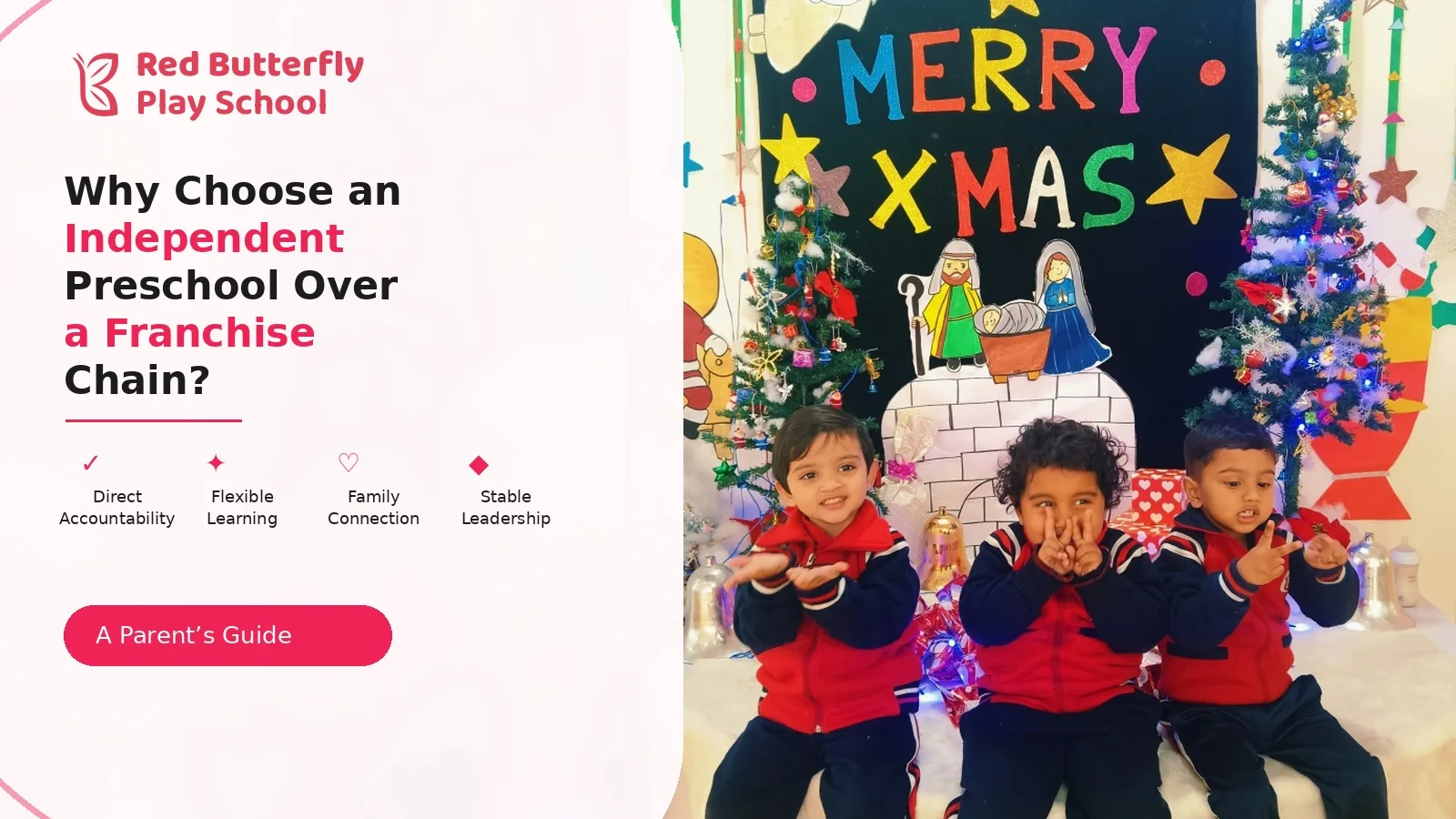
- Direct accountability. In an independent school, the people responsible for admissions, curriculum decisions, and day-to-day operations are typically present and personally accountable, rather than distant corporate decision-makers several layers removed from any individual classroom.
- Genuine flexibility to adapt. Because an independent school is not bound by a rigid, centrally dictated franchise playbook, it has more room to shape its curriculum, class sizes, and daily structure around the specific needs of the families it actually serves.
- A closer relationship between families and the school. Independent schools, particularly smaller ones rooted in a specific community, often build closer, more personal relationships with families over time.
- Consistency of leadership. Franchise branches occasionally change ownership or management as licensing arrangements shift, which can disrupt continuity for enrolled families. An independently owned school's leadership and educational philosophy tend to remain more stable over time.
What Independent Schools Need to Prove, That Chains Don't Have To
It would be inaccurate, and unfair to parents, to suggest that independent status alone guarantees quality — it does not. National brand recognition can create an assumption of quality and consistency that an independent school has to earn more deliberately, since it cannot rely on an established national reputation. This is precisely why it becomes even more important, when evaluating an independent preschool, to ask direct, specific questions rather than relying on brand trust alone: What is the actual teacher-to-child ratio in the classroom my child would join? What does a typical day look like? What specific safety measures are in place? How experienced and qualified is the current teaching staff?
A strong independent preschool should be able to answer these questions clearly, specifically, and confidently — and a school visit remains the single best way to judge this directly, regardless of whether the school is independent or part of a larger chain.
How Red Butterfly Approaches This
Red Butterfly Play School & Day Care, located within NBCC Heights Society, Sector 89, Gurugram, operates as an independently run school rather than a franchise branch of a larger national chain. This shapes several aspects of how the school operates day to day.
The curriculum across Pre-Nursery, Nursery, LKG, UKG, and the Mini Marvels (Prep) stage has been developed specifically for the school's own classrooms, rather than adopted wholesale from a standardised national template. The school maintains a teacher-to-child ratio of approximately 2:15 in its youngest classrooms — a specific, checkable commitment rather than a marketing claim — and the leadership team remains directly, personally involved in admissions, curriculum decisions, and day-to-day campus operations.
Being physically located within NBCC Heights itself, rather than in a standalone commercial building serving a wide, dispersed catchment, also allows Red Butterfly to build the kind of close, ongoing relationship with resident families across Sector 89 and the surrounding Hayatpur pocket that is harder to replicate at the scale a large franchise chain typically operates at.
The Meaning Behind the Name
Red Butterfly's own identity reflects this same personal, considered approach: "Red" is intended to represent willpower, love, energy, and courage, while "butterfly" symbolises tenderness, innocence, and growth. This is not incidental branding — it reflects a deliberate intention to create a nurturing, unhurried environment where each child's individuality is genuinely recognised, rather than processed through a standardised, high-volume operating model.
Questions Worth Asking, Regardless of Which Type of School You Choose
- What is the actual teacher-to-child ratio in the specific classroom my child would join, not just a school-wide average?
- How long has current teaching staff been with the school?
- Who is directly responsible for day-to-day decisions at this specific campus?
- What does a typical day genuinely look like, hour by hour?
- What safety measures are in place, and can I see them directly during a visit?
Frequently Asked Questions
Is an independent preschool necessarily better than a franchise chain?
Not automatically — quality varies within both models. What matters most is the specific school, its teachers, its safety practices, and its curriculum, evaluated directly rather than assumed from brand reputation alone.
Do independent preschools follow the same academic standards as franchise chains?
Reputable independent preschools, including Red Butterfly, structure their curricula around the same broader frameworks — such as NEP 2020's Foundational Stage principles — that guide franchise chains, while retaining flexibility to adapt specifics to their own classrooms and community.
Are independent preschools generally more affordable than franchise chains?
This varies considerably by school and is not a reliable generalisation in either direction. Fee structures should be confirmed directly with each specific school under consideration.
How can I judge the quality of an independent preschool if it doesn't have a well-known brand name?
A school visit remains the most reliable method — observing the classroom environment, meeting teachers directly, and asking specific questions about ratios, safety, and curriculum, rather than relying on brand recognition as a proxy for quality.
A Considered Choice, Not a Default One
Choosing between an independent preschool and a national franchise chain is not a decision with a universally correct answer — it depends on what a specific family values and what a specific school can genuinely deliver. What matters most is moving past brand recognition alone, and evaluating each option on its own specific merits: its teachers, its safety practices, its curriculum, and the relationship it is genuinely able to build with your family.
Families in Sector 89, Hayatpur, and the surrounding Gurugram community are welcome to visit Red Butterfly to see this approach directly.