
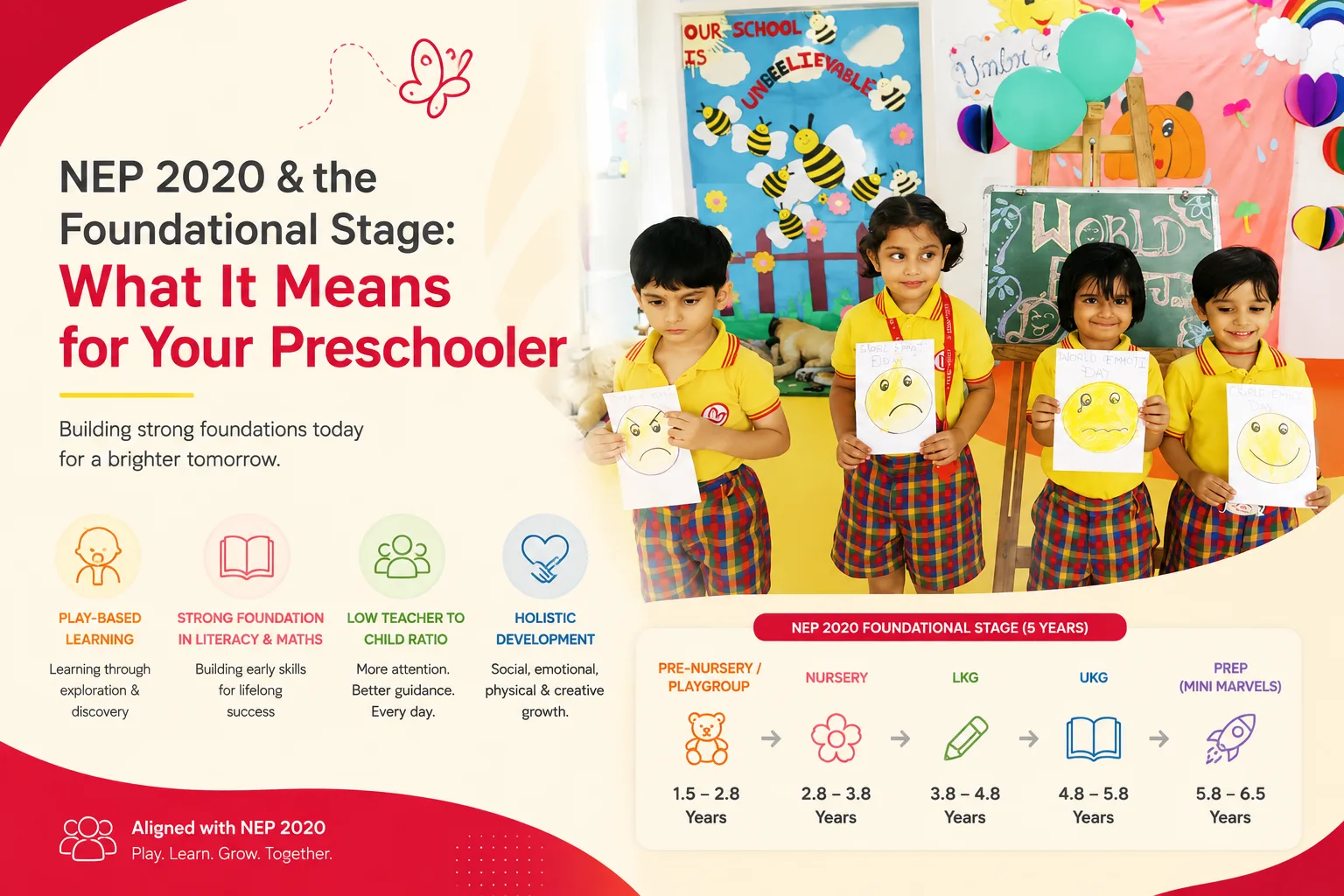
If you have researched preschools in India over the last few years, you have almost certainly come across the term "NEP 2020" — usually attached to a school's marketing material as a mark of credibility. But what does NEP 2020 actually say about early childhood education, and what should it mean, practically, for a parent choosing a preschool for a two, three, or four-year-old today? This article breaks down the policy in plain terms and explains how it shapes the way schools like Red Butterfly Play School & Day Care approach the earliest years of a child's education.
What is NEP 2020?
The National Education Policy (NEP) 2020 is India's most significant overhaul of its education framework in decades. Among its many changes, one of the most consequential for early childhood education was the replacement of the older 10+2 schooling structure with a new 5+3+3+4 structure. This might sound like an administrative detail, but it represents a genuine shift in how early childhood is understood and valued within the broader education system.
Under this structure, formal schooling is now conceived of as beginning much earlier than Class 1 — recognising, for the first time at a policy level, that the years before Class 1 are not merely a "waiting period" before real education begins, but a foundational stage in their own right.
Understanding the 5+3+3+4 Structure
The four stages under NEP 2020 are:
- Foundational Stage (5 years) — three years of pre-primary/preschool education, followed by Grades 1 and 2, together spanning approximately ages 3 to 8.
- Preparatory Stage (3 years) — Grades 3 to 5, roughly ages 8 to 11.
- Middle Stage (3 years) — Grades 6 to 8, roughly ages 11 to 14.
- Secondary Stage (4 years) — Grades 9 to 12, roughly ages 14 to 18.
For parents of preschool-aged children, the stage that matters most is the first one: the Foundational Stage. This is the first time that pre-primary education — the years many of us grew up thinking of as "just playschool" — has been formally recognised as an integral, structured part of a child's educational journey rather than an optional add-on before "real school" begins.
What the Foundational Stage Actually Prioritises
NEP 2020 is explicit that the Foundational Stage should be built primarily around play-based, activity-based, and discovery-based learning, rather than the rote memorisation and rigid textbook-driven methods that have historically dominated much of Indian schooling from an early age. This is a deliberate and evidence-informed choice: extensive research in child development consistently shows that young children absorb language, numeracy concepts, motor skills, and emotional regulation far more effectively through structured play, exploration, and social interaction than through passive instruction or repetitive drilling.
In practical terms, this means a NEP-aligned Foundational Stage classroom should look less like a scaled-down primary school classroom, and more like a thoughtfully designed play environment — with storytelling, rhymes, sensory activities, art and craft, music and movement, and hands-on materials, all deliberately structured around specific developmental goals rather than being purely recreational.
Foundational Literacy and Numeracy (FLN)
A closely related priority under NEP 2020 is Foundational Literacy and Numeracy (FLN) — the ability to read, write, and perform basic number operations with genuine understanding by around the end of Grade 3. The policy treats this as a national mission of sorts, on the basis that a child who does not build strong foundational literacy and numeracy skills in these early years is likely to struggle disproportionately in every subject that follows.
For preschools, this translates into a responsibility to introduce early literacy and numeracy concepts — letter sounds, number recognition, pattern awareness, and simple vocabulary — in ways that are age-appropriate, playful, and consistent, rather than either neglecting these skills entirely or introducing them through pressure and repetition.
Teacher-to-Child Ratios Under NEP 2020
NEP 2020 also addresses classroom structure directly, mandating a pupil-teacher ratio of under 30:1 across schools generally. For the Foundational Stage specifically, the policy's spirit — and national data from sources such as UDISE+ — points toward considerably lower ratios in practice, with figures closer to 10:1 reported nationally for foundational-stage classrooms. The reasoning is straightforward: younger children require significantly more individual attention, guidance, and observation than older students, simply because they are still developing the basic tools of communication, self-regulation, and independence.
This is one of the more practical, checkable ways a parent can evaluate whether a preschool is genuinely aligned with NEP principles rather than simply using the term as marketing language: ask directly about class size and teacher-to-child ratio, and compare it against national benchmarks.
How Red Butterfly Aligns With These Principles
Red Butterfly Play School & Day Care, situated in NBCC Heights, Sector 89, Gurugram, has structured its programmes — Pre-Nursery, Nursery, LKG, UKG, and the school-readiness stage it calls Mini Marvels (Prep) — around this same play-based, developmentally staged philosophy that NEP 2020 champions. Classrooms maintain a teacher-to-child ratio of approximately 2:15, considerably below the 30:1 ceiling set nationally, allowing teachers meaningfully more room to observe, support, and adapt to each child individually.
The daily structure at Red Butterfly reflects the Foundational Stage's emphasis on balance: circle time, storytelling, rhymes, art and craft, music and dance, outdoor play, and structured "learning time" are all built into each day, rather than concentrating academic content into isolated worksheet-driven sessions. Early literacy and numeracy concepts are introduced progressively across the Pre-Nursery through UKG stages, in line with the broader intent of Foundational Literacy and Numeracy goals, while care is taken not to push children into premature or pressured academic performance.
The Mini Marvels programme, in particular, exists specifically to serve the bridging function that NEP 2020 envisions for the final year of the Foundational Stage — helping children consolidate early literacy, numeracy, social, and emotional skills before stepping into the more structured expectations of Grade 1.
What This Means for You as a Parent
If you are evaluating preschools in Sector 89, Hayatpur, or elsewhere in Gurugram, NEP 2020 gives you a genuinely useful framework for asking better questions, rather than simply looking for the phrase "NEP-aligned" on a school's website. Some questions worth asking directly:
- What does a typical day actually look like, hour by hour?
- What is the real teacher-to-child ratio in the classroom my child would join, not just the school-wide average?
- How is early literacy and numeracy introduced — through play and hands-on activity, or through worksheets and repetition?
- How does the school balance academic preparation with social, emotional, and physical development?
A preschool that can answer these questions clearly and specifically — rather than in vague marketing terms — is more likely to be genuinely implementing the spirit of NEP 2020's Foundational Stage, rather than simply referencing it. If you're also weighing exactly which stage — Pre-Nursery, Nursery, LKG, or UKG — fits your child's age, our companion guide covers that in depth.
A Final Thought
NEP 2020 represents a meaningful, evidence-based shift in how India approaches the earliest years of education — treating play, exploration, and foundational skill-building as serious educational work rather than a precursor to "real school." For parents, understanding this framework is less about memorising policy details and more about knowing what a genuinely good foundational-stage classroom should look like, so that the choice of preschool can be made with real clarity rather than marketing language alone.
Parents in Sector 89 and the surrounding Gurugram community are welcome to visit Red Butterfly Play School & Day Care in NBCC Heights to see this approach in practice.