
One of the most common questions new parents ask when they begin researching early education is deceptively simple: "What age should my child be for playgroup, nursery, LKG, or UKG?" The answer matters a great deal, because getting the stage right affects everything from a child's comfort in the classroom to how smoothly they transition into formal schooling later on. This guide walks through how Indian preschools typically structure these stages, what the National Education Policy (NEP) 2020 says about age cut-offs, and how Red Butterfly Play School & Day Care in Sector 89, Gurugram, has structured its own programmes around these principles.
Why Age Bands Matter So Much in Early Childhood
Between the ages of 1.5 and 6 years, children develop at an extraordinary pace — language, motor skills, emotional regulation, and social awareness can all shift noticeably within a matter of months. This is precisely why preschools group children into fairly narrow age bands rather than broad ranges. A curriculum, classroom routine, and set of learning goals appropriate for a two-year-old will look quite different from one designed for a five-year-old, even though both may loosely fall under the "preschool" umbrella.
Enrolling a child in a stage that is not well matched to their developmental age — whether too advanced or too basic — can lead to frustration, disengagement, or unnecessary pressure. This is why understanding the standard stages, and how a specific school defines them, is worth doing carefully before admission.
The Standard Indian Preschool Pattern
Across most CBSE-aligned schools in India, the broad convention for early years education follows this general pattern:
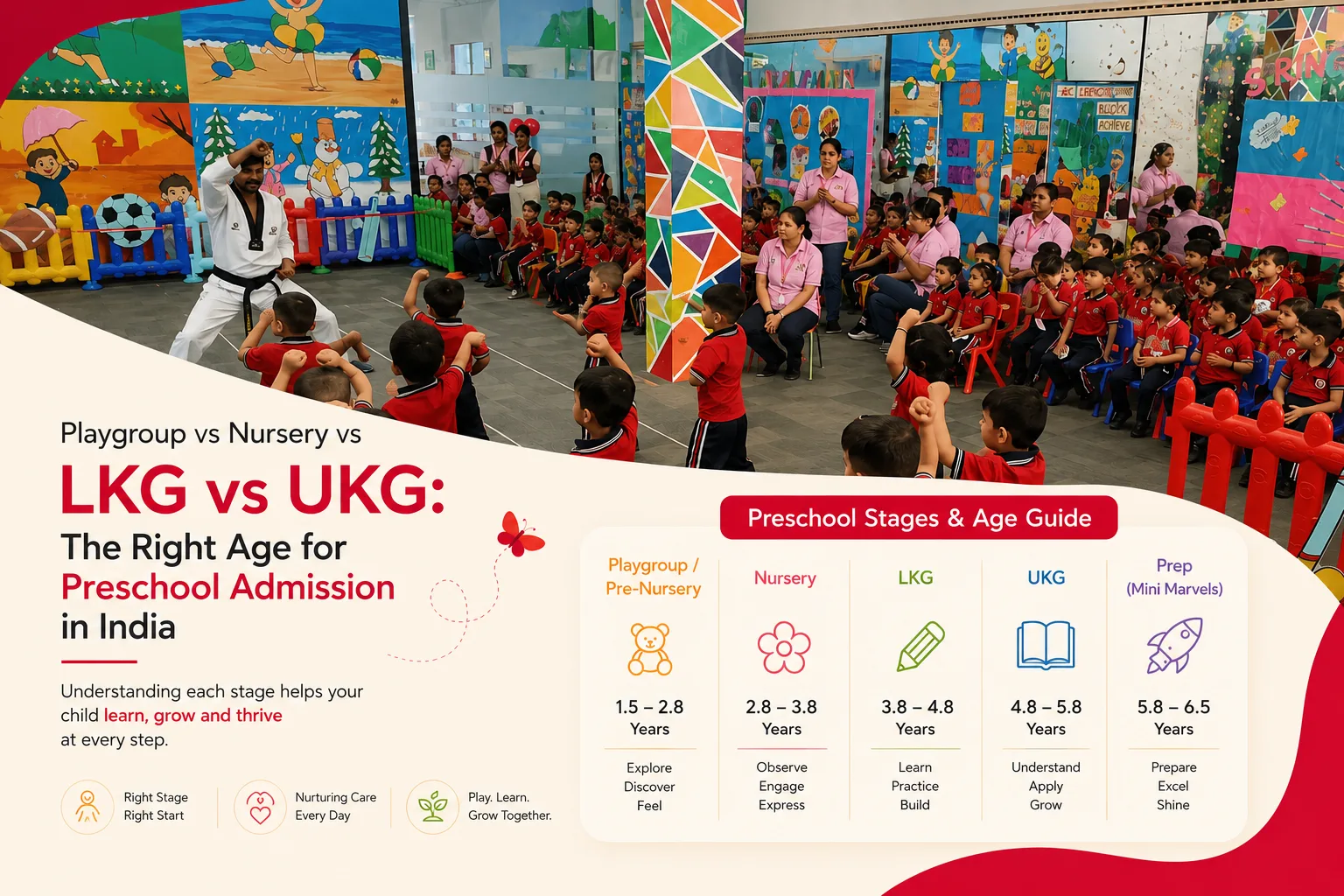
- Playgroup / Pre-Nursery — around 1.5–2.8 years
- Nursery — around 2.8–3.8 years
- LKG (Lower Kindergarten) — around 3.8–4.8 years
- UKG (Upper Kindergarten) — around 4.8–5.8 years
- Prep / School Readiness — around 5.8–6.5 years
- Class 1 — 6 years and above
It is important to note that these age bands are not universal — they vary slightly from school to school and are also influenced by regional cut-off dates. Under NEP 2020's CBSE-aligned framework, a child is generally expected to be 3 years old for Nursery, 4 for LKG, 5 for UKG, and 6 completed for Class 1, calculated as of a specific cut-off date. In North India, including Gurugram, this cut-off is typically March 31, meaning a child's exact eligible age is assessed as of that date each academic year — not the date of admission enquiry. This is different from Maharashtra, which generally uses December 31, or Karnataka, which uses June 1, so it is always worth confirming the specific cut-off policy of the school and region you are enquiring in.
What Each Stage Typically Focuses On
Playgroup / Pre-Nursery is designed as a gentle introduction to the idea of "school" itself. At this stage, the focus is almost entirely on comfortable settling-in, sensory exploration, early listening and speaking skills, and simple social interaction — sharing, taking turns, and getting used to a routine away from a parent or primary caregiver. Structured academic content, such as letter or number recognition, is introduced only in the lightest, most playful form.
Nursery builds on this foundation. Children begin more consistent exposure to letters, numbers, colours, and shapes, but still primarily through play, rhymes, storytelling, and hands-on activities rather than worksheets. Social skills become more structured too, with an increased emphasis on group activities, classroom rules, and early independence — such as eating and using the washroom with less assistance.
LKG typically marks a shift toward slightly more structured early literacy and numeracy. Children are commonly expected to begin recognising and writing letters, identifying letter sounds through phonics, counting with more confidence, and following two-to-three-step instructions. Emotional and social development remain just as important, with a growing focus on classroom discipline, communication, and collaborative play.
UKG is generally the final preparatory stage before formal schooling begins. Academic expectations increase further — reading simple words and short sentences, basic addition and subtraction, and more developed pencil control — while still maintaining a play-based, low-pressure classroom environment. This is also the stage where "school readiness" as a concept becomes central: can the child sit, listen, and participate for longer stretches, follow multi-step instructions, and manage themselves with growing independence?
Prep / School Readiness programmes, sometimes given a distinct identity by individual schools, exist specifically to bridge the gap between kindergarten and Class 1. At Red Butterfly, this stage is branded as Mini Marvels — a programme built around the idea that every child entering this final preparatory year is, in their own way, already full of potential, and simply needs the right structure and encouragement to step confidently into formal schooling.
How Red Butterfly Structures Its Programmes
Red Butterfly Play School & Day Care, located in NBCC Heights, Sector 89, Gurugram, follows a structured, age-banded approach across five core stages:
- Pre-Nursery, for children roughly 1.5 to 2.8 years
- Nursery, for children roughly 2.8 to 3.8 years
- LKG, for children roughly 3.8 to 4.8 years
- UKG, for children roughly 4.8 to 5.8 years
- Prep (Mini Marvels), for children roughly 5.8 to 6.5 years
Each stage maintains a class strength of around 15–20 children with a supportive teacher-to-child ratio, allowing teachers to observe and respond to each child's individual pace rather than teaching to a rigid, one-size-fits-all timeline. This is particularly important in the early years, where two children of the same chronological age can be at quite different developmental stages. This same play-based, developmentally staged philosophy is also what NEP 2020's Foundational Stage is built around.
Common Parent Questions on This Topic
My child's birthday falls close to the cut-off date — which stage should they join?
This is one of the most frequent admissions questions, and it deserves an honest answer rather than a rushed one. Schools generally recommend erring toward the stage that matches a child's developmental readiness — social, emotional, and physical — rather than admitting purely by calendar age, especially when a birthday falls close to the cut-off.
Is there a test or interview for admission?
No academic testing is involved in early years admission. Most preschools, including Red Butterfly, conduct a brief, informal interaction between the child, parents, and the admissions team, simply to understand the child's comfort level and any specific needs — not to evaluate or filter based on ability.
What if my child hasn't attended any preschool before Nursery or LKG?
This is entirely normal and not a barrier to admission at the appropriate stage. Teachers are experienced in helping children settle in regardless of prior preschool exposure, and a short settling-in period is a standard part of the process.
Can my child skip a stage if they seem "ahead"?
This is generally discouraged, even when a child shows strong early academic skills, because social and emotional development at this age often does not move at the same pace as academic ability. Most schools, including Red Butterfly, recommend keeping children with same-age peers unless there is a strong developmental reason to consider otherwise.
A Note for Parents Beginning Their Search
If you are a parent in Sector 89, Hayatpur, or the wider Gurugram corridor beginning to research preschool admission for the 2026–27 academic year, the most useful first step is simply to understand which stage best matches your child's current age and developmental readiness — not the stage with the most impressive-sounding name. A well-matched stage, taught by attentive teachers in a genuinely play-based environment, will always serve a young child better than an accelerated or mismatched one.
Parents interested in learning more about Red Butterfly's Pre-Nursery, Nursery, LKG, UKG, or Mini Marvels (Prep) programmes are welcome to reach out directly to discuss age eligibility and arrange a school visit.