
As the UKG year draws toward its close, one question begins to occupy a growing amount of parental attention: is my child actually ready for Grade 1? It is a fair and important question, but one often approached with more anxiety than it needs to carry. This article looks at what "school readiness" genuinely means, the different dimensions it covers beyond pure academics, and how parents can think through this transition with more clarity and less worry.
School Readiness Is Broader Than Academic Ability
One of the most common misunderstandings among parents is that school readiness is primarily, or even exclusively, an academic question — can my child read, write, and count well enough? While academic foundation certainly matters, genuine school readiness spans several distinct dimensions, and a child who is strong in one area but still developing in another is entirely normal, not a cause for concern.
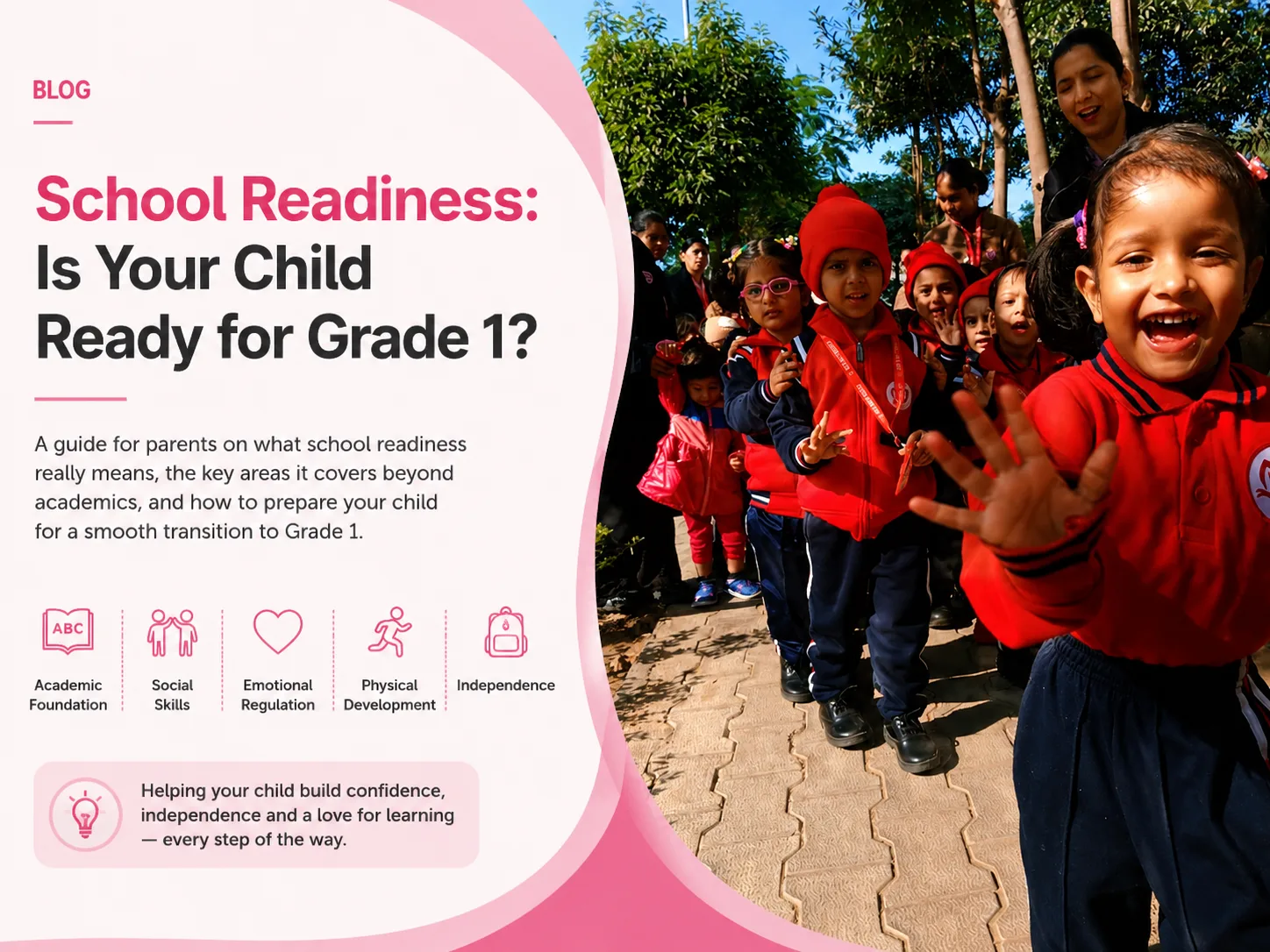
Early childhood educators generally think about readiness across five interconnected areas: academic foundation, social skills, emotional regulation, physical development, and independence. A child does not need to excel equally across all five to be genuinely ready for Grade 1 — what matters is a reasonable, functional level of development across the full picture, not perfection in any single dimension.
Academic Foundation
By the end of UKG, most schools expect a child to recognise and write both capital and lowercase letters, read simple words and short sentences, write basic sentences with reasonable independence, recognise numbers into several hundred, and perform simple addition and subtraction. These benchmarks describe a general expectation, not a rigid pass-or-fail threshold — children develop at genuinely different paces, and a degree of variation within a normal range is entirely expected and manageable within a well-run Grade 1 classroom.
Social Skills
Grade 1 classrooms are typically larger and less individually supervised than preschool classrooms, making social competence a genuinely important readiness factor. Key indicators include the ability to work cooperatively with peers, share and take turns without significant difficulty, follow classroom rules and routines with reasonable consistency, and interact respectfully with both teachers and classmates. A child who has had consistent exposure to group learning throughout Nursery, LKG, and UKG generally builds these skills naturally over time.
Emotional Regulation
Perhaps less discussed than academic or social readiness, emotional regulation is an equally important factor in a smooth Grade 1 transition. This includes the ability to express feelings using words rather than purely through behaviour, manage frustration or disappointment with growing independence, show patience when a task proves difficult, and adapt reasonably well to changes in routine. Children continue developing these skills well beyond age six, and a Grade 1 classroom with attentive teachers should still provide meaningful support here — readiness does not mean emotional maturity is "finished," simply that a functional baseline is in place.
Physical Development
Grade 1 classrooms generally expect a somewhat higher degree of fine and gross motor control than kindergarten: steady pencil grip and handwriting control, the ability to sit and focus for longer stretches, coordination sufficient for activities like cutting with scissors safely, and general physical stamina appropriate for a longer school day. Regular physical play and structured fine motor activities throughout the preschool years typically build this foundation gradually and naturally.
Independence
Grade 1 classrooms offer considerably less individual adult supervision than preschool settings, making a degree of practical independence genuinely important — managing personal belongings, using the washroom independently, eating without significant assistance, and following multi-step instructions without constant reminders. These are skills built specifically through daily preschool routines over the preceding years, rather than introduced abruptly in the final term before Grade 1.
What If My Child Isn't "There Yet" in Some Areas?
This is an entirely common and manageable situation, not a sign that something has gone wrong. Development in early childhood is rarely linear or evenly distributed across every skill area — a child may be well ahead in language and reading, while still building confidence in fine motor tasks or peer interaction, and this kind of unevenness is developmentally typical rather than exceptional. The most productive response is not comparison against other children, but a specific, honest conversation with your child's current teachers about which areas might benefit from additional focus in the months before Grade 1.
How a Dedicated Prep or Bridging Year Helps
This is precisely the role a dedicated Prep or school-readiness year is designed to serve. At Red Butterfly, this stage is called Mini Marvels, and it exists specifically to consolidate academic, social, emotional, physical, and independence-related skills across all five readiness dimensions — through a curriculum that stays largely play-based and hands-on, rather than shifting abruptly into a purely desk-based, high-pressure academic format. Our in-depth look at the Mini Marvels programme walks through a typical day and what parents can expect from the year.
Practical Steps Parents Can Take at Home
- Read together daily, even briefly. Shared reading time continues to build vocabulary, comprehension, and a positive association with books well into the school-readiness stage.
- Encourage independent tasks at home. Simple responsibilities — packing a school bag, choosing and putting on clothes, tidying toys — build the same independence skills a Grade 1 classroom will expect.
- Maintain consistent routines. Predictable daily rhythms, particularly around bedtime and mornings, support the emotional stability and self-regulation that ease a school transition.
- Talk openly and positively about Grade 1. Framing the upcoming transition with warmth and specific, concrete detail — rather than vague or anxious language — helps a child approach the change with curiosity rather than apprehension.
- Stay closely connected with current teachers. Teachers who have observed your child throughout the year are typically best positioned to offer specific, individualised guidance on readiness, rather than relying on general age-based benchmarks alone.
Frequently Asked Questions
Is there a formal "readiness test" before Grade 1?
Most reputable schools, including Red Butterfly, do not use formal testing to determine Grade 1 readiness. Ongoing teacher observation throughout UKG and any Prep stage provides a more accurate, holistic picture than a single assessment could.
My child's birthday falls close to the cut-off date — should we wait a year?
This is a genuinely individual decision that depends more on developmental readiness across the areas described above than on age alone. A conversation with current teachers, who have observed your child directly, is usually more useful than a decision based purely on birth date.
What if my child is academically strong but socially or emotionally less mature?
This is common, and does not necessarily mean delaying Grade 1 is the right choice. A dedicated bridging year, or continued focused support during the final preschool stage, can often close this gap meaningfully within a matter of months.
How can I tell if my child's current preschool is adequately preparing them for Grade 1?
Ask specifically what benchmarks the school tracks across academic, social, emotional, physical, and independence-related development, and request a direct, honest update on where your child currently stands across each area.
A Transition Worth Preparing For, Not Worrying About
School readiness is best understood not as a single hurdle to clear, but as a gradual process built steadily across the preschool years — through consistent routines, play-based learning, and attentive teachers who understand each child individually. With the right support in the final preparatory year, the vast majority of children move into Grade 1 with genuine confidence, rather than apprehension.
Parents in Sector 89, Hayatpur, and the surrounding Gurugram community are welcome to discuss school-readiness support, including the Mini Marvels programme, directly with the Red Butterfly team.