
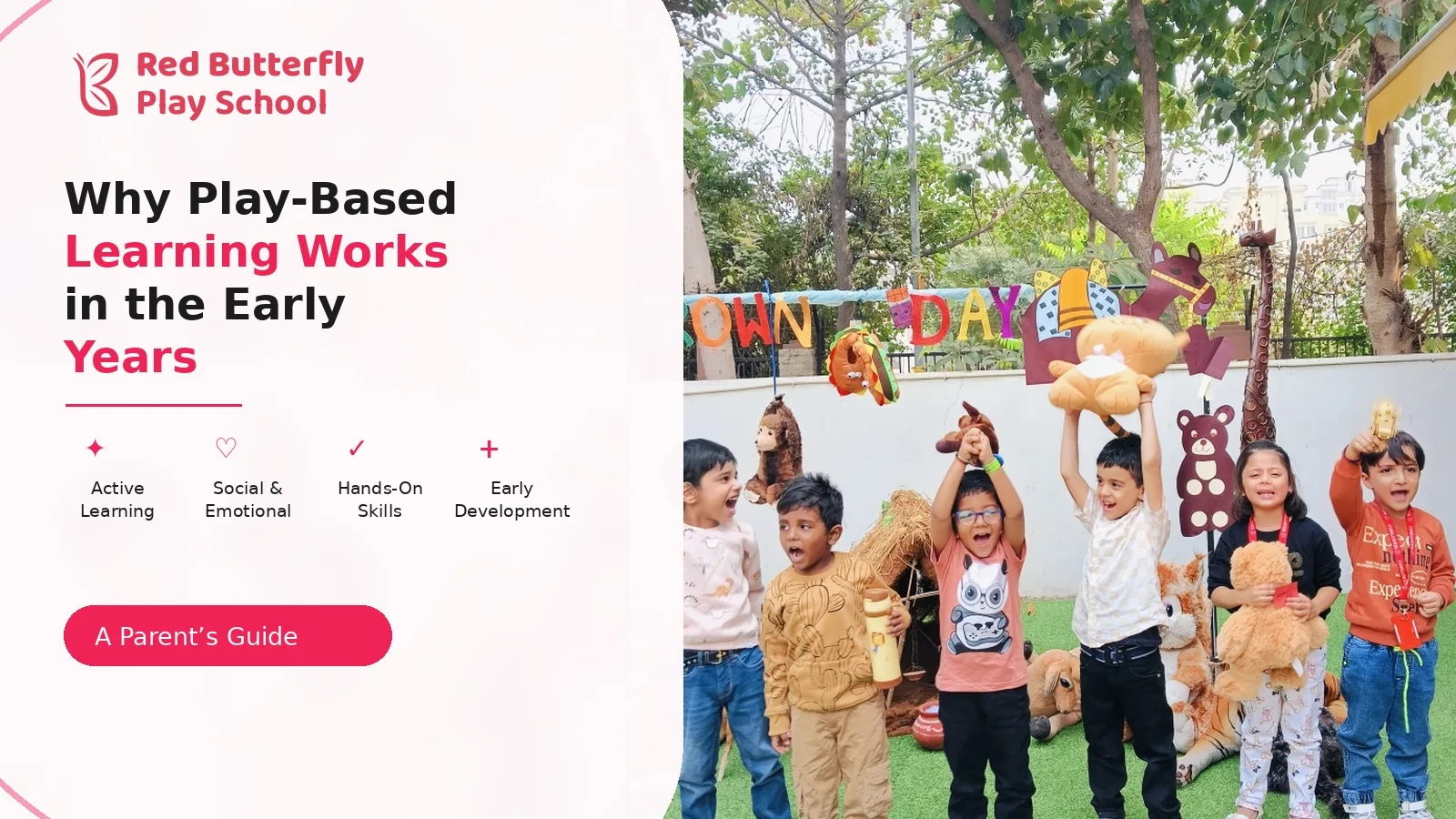
Walk into almost any well-regarded preschool classroom today and you will likely see the same thing: children building with blocks, acting out stories, sorting objects by colour, singing rhymes, and moving freely between activity corners, rather than sitting at desks completing worksheets. This is not a lack of academic rigour. It is, in fact, the deliberate application of decades of child development research, and it forms the backbone of how India's National Education Policy (NEP) 2020 now frames early childhood education. This article explains why play-based learning works, what it actually looks like in practice, and how it shapes the approach at Red Butterfly Play School & Day Care.
What Play-Based Learning Actually Means
It is worth clearing up a common misconception early on: play-based learning does not mean an absence of structure, or simply letting children entertain themselves while adults supervise passively. Genuine play-based learning is deliberately designed, with specific developmental goals built into each activity — a sensory bin is not "just play," it is a structured opportunity to build vocabulary, fine motor coordination, and early scientific observation, all at once, precisely because a young child engages far more deeply with an activity that feels like play than with one that feels like instruction.
The distinction that matters is between passive instruction — where a teacher delivers information and a child is expected to absorb and repeat it — and active, guided play, where a child explores, experiments, and constructs understanding through direct experience, with a teacher shaping the environment and gently guiding the process rather than dictating every step.
The Developmental Case for Play
- Language develops through interaction, not repetition alone. Young children build vocabulary and sentence structure far more effectively through real conversation, storytelling, and social play than through rote memorisation or flashcard drilling.
- Motor skills need physical, hands-on practice. Fine motor skills — the hand strength and coordination eventually needed for handwriting — develop through activities like threading beads, moulding clay, tearing and pasting, and manipulating small objects, not through early handwriting drills alone.
- Numeracy concepts are built through concrete experience before abstract symbols. A child who has physically sorted, counted, and compared real objects builds a much sturdier foundation for later abstract number work than a child introduced to number symbols before having handled quantities directly.
- Social and emotional skills cannot be taught through lecture. Sharing, taking turns, negotiating conflict, and reading others' emotional cues are skills that can only genuinely develop through repeated social practice, which is precisely what structured group play provides.
- Attention span and self-regulation develop gradually, through engagement. Activities that actively engage a child's curiosity and physical involvement naturally extend their capacity for focus, gradually building the sustained-attention skills that more formal schooling will later require.
What This Looks Like in a Well-Run Classroom
A genuinely play-based classroom is not chaotic or unstructured — it follows a deliberate daily rhythm, typically including circle time for social connection and discussion, dedicated learning blocks where specific concepts are introduced through games and hands-on materials, art and craft for creative expression and fine motor development, music and movement for rhythm and coordination, outdoor play for physical development and social interaction, and storytelling for language and imagination.
Crucially, teachers in a play-based classroom are far from passive. They observe closely, ask open-ended questions, introduce new vocabulary naturally within the context of play, and gently extend a child's thinking — for example, encouraging a child stacking blocks to consider "which block might make the tower more stable" rather than simply supervising from a distance.
Play-Based Learning and NEP 2020
India's National Education Policy 2020 formally recognises this approach, establishing play-based, activity-based, and discovery-based learning as the core pedagogical principle for the early Foundational Stage of a child's education — the years spanning roughly ages 3 to 8, including the preschool years before Class 1. This represents a meaningful policy-level validation of an approach that early childhood educators and researchers have advocated for decades: that structured play is not a lesser alternative to "real" academic instruction in the early years, but the most developmentally appropriate and effective method available.
Balancing Play With Foundational Literacy and Numeracy
It is worth addressing directly a concern some parents raise: does an emphasis on play come at the cost of academic preparation? The evidence, and the intent of frameworks like NEP 2020, suggest the opposite. Foundational Literacy and Numeracy (FLN), a national policy priority, is not abandoned in a play-based classroom; it is introduced through play, in age-appropriate, engaging ways, rather than delayed altogether. A well-designed play-based preschool curriculum still progresses children steadily toward letter recognition, phonics, early reading, counting, and basic number sense — the method of teaching differs, not the underlying academic ambition.
How Red Butterfly Applies This Philosophy
At Red Butterfly, located in NBCC Heights, Sector 89, this philosophy shapes the structure of every programme, from Pre-Nursery through Mini Marvels (Prep). Each day balances circle time, storytelling, rhymes, sensory play, art and craft, music and dance, and outdoor activity with a gradual, age-appropriate progression through early literacy and numeracy concepts. A teacher-to-child ratio of approximately 2:15 in the youngest classrooms supports this approach directly, since genuinely responsive, play-based teaching depends on teachers having the capacity to observe and engage with individual children, rather than managing a large group through a single fixed activity at a time.
Frequently Asked Questions
Does play-based learning mean my child won't be ready for LKG or UKG academically?
No. Play-based classrooms still introduce literacy and numeracy concepts progressively; the method of teaching differs from a worksheet-driven approach, but the academic trajectory toward reading, writing, and basic maths readiness remains intact.
How can I tell if a classroom's "play-based" approach is genuinely structured, or simply unsupervised free time?
Ask specifically what a typical day looks like, hour by hour, and what developmental goals are attached to specific activities. A well-run play-based classroom should be able to explain the purpose behind each activity, not just describe it as "fun."
Is play-based learning appropriate for older preschool stages like UKG and Prep, or only for younger children?
Play-based principles remain relevant throughout the Foundational Stage, though the balance naturally shifts to include more structured academic content as children approach Class 1, while still maintaining hands-on, engaging teaching methods rather than a purely desk-based format.
A Foundation Built to Last
The years before Class 1 are not a waiting period before "real" learning begins — they are, according to both developmental science and current national education policy, among the most formative years of a child's entire educational journey. A genuinely play-based approach, thoughtfully structured and delivered by attentive teachers, gives young children the strongest possible foundation for everything that follows.
Parents in Sector 89, Hayatpur, and the surrounding Gurugram community are welcome to visit Red Butterfly to see this approach in practice.