
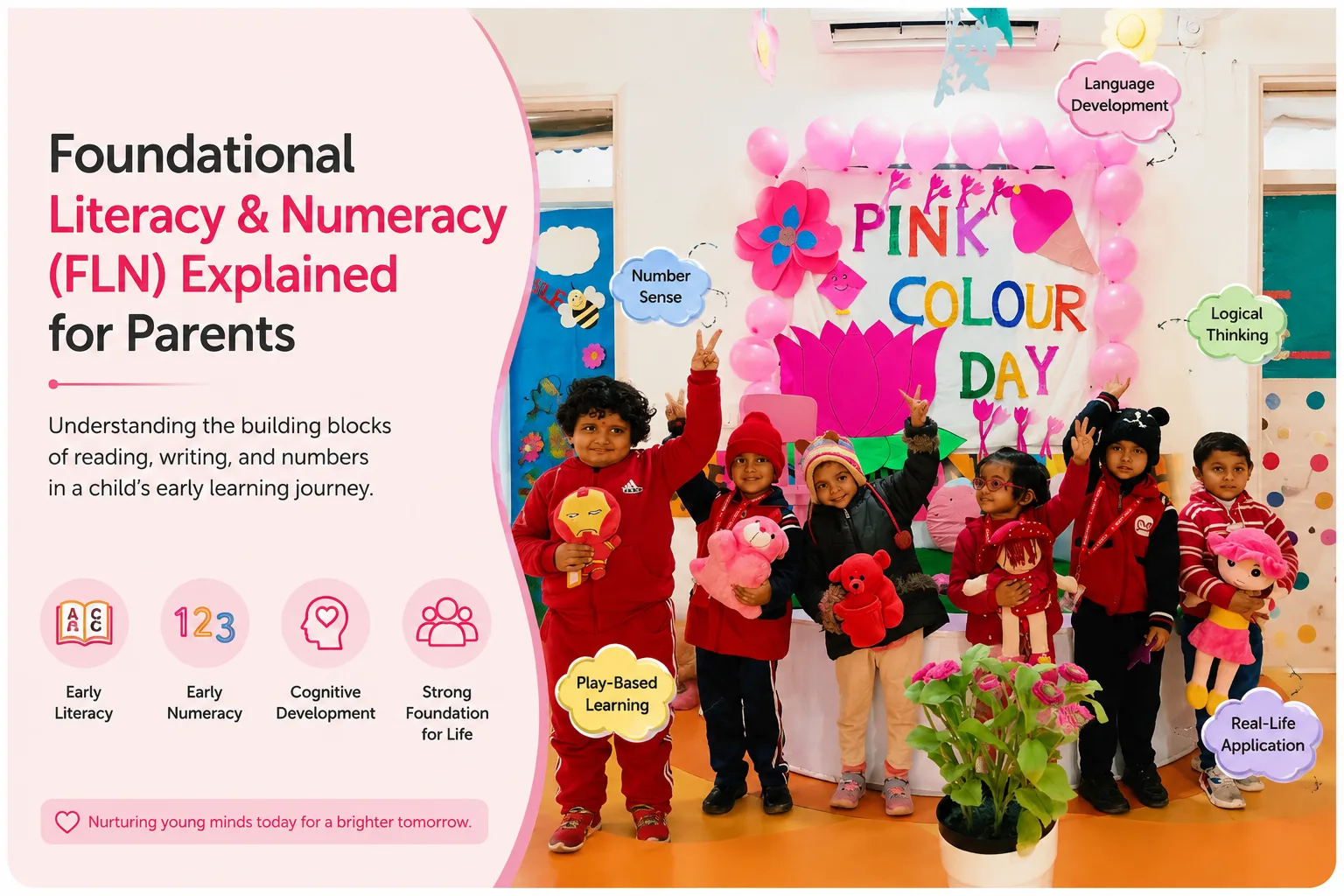
Among the many terms that appear in discussions of India's National Education Policy (NEP) 2020, "Foundational Literacy and Numeracy," often abbreviated as FLN, is one of the most consequential — and one of the least understood by parents outside the education sector. This article explains, in plain terms, what FLN actually means, why it has become such a significant national priority, and what it looks like in practice within a well-run preschool classroom.
What Is Foundational Literacy and Numeracy?
Foundational Literacy and Numeracy refers to a child's ability to read and comprehend simple text, and to perform basic number operations, with genuine understanding rather than rote memorisation, generally by around the end of Grade 3. Research consistently shows that a child who does not build strong, genuine literacy and numeracy skills in these early years tends to struggle disproportionately across every subject that follows. NEP 2020 explicitly frames FLN as an urgent national mission, recognising that gaps left unaddressed in the early years become progressively harder to close.
What Foundational Literacy Actually Involves
- Phonemic and phonics awareness. The ability to recognise and manipulate individual sounds within words, and connect letters with their corresponding sounds.
- Vocabulary development. A growing bank of words a child understands and can use, built primarily through conversation, storytelling, and rich verbal interaction.
- Print awareness. Understanding basic concepts about how written language works — that text is read left to right, that words are separated by spaces, and that stories have a beginning, middle, and end.
- Early reading fluency. Progressing from recognising individual letters and sounds, to blending them into simple words, to eventually reading short, familiar sentences.
- Comprehension. Not simply decoding words, but genuinely understanding what has been read or heard.
What Foundational Numeracy Actually Involves
- Number sense. Understanding what numbers actually represent, not simply a symbol to be memorised in sequence.
- Counting with understanding. Counting objects accurately, understanding one-to-one correspondence, and recognising written numerals alongside their corresponding quantities.
- Basic operations. Introducing simple addition and subtraction through concrete, hands-on methods before progressing to abstract symbols.
- Pattern and shape recognition. Identifying and extending simple patterns, and recognising basic shapes.
- Measurement and comparison. Early concepts such as big/small, more/less, heavy/light, and long/short.
How FLN Is Taught: Play, Not Just Drilling
A common misconception is that building strong FLN requires early, intensive academic drilling — worksheets, repetition, and formal instruction introduced as early as possible. The evidence, and NEP 2020's own guidance, points in the opposite direction. FLN skills are most effectively built through play-based, activity-driven methods: phonics games, storytelling, sensory number activities, hands-on counting with real objects, and rich verbal interaction throughout the day.
How Red Butterfly Approaches FLN
At Red Butterfly Play School & Day Care in NBCC Heights, Sector 89, foundational literacy and numeracy skills are introduced progressively across the Nursery, LKG, and UKG years, through phonics activities, storytelling and picture-reading sessions, number recognition games, sensory counting and sorting activities, and pre-writing practice. By the Mini Marvels (Prep) stage, children are expected to read simple sentences, write independently, and work confidently with numbers into the hundreds, alongside basic addition, subtraction, and simple word problems. A teacher-to-child ratio of approximately 2:15 in the youngest classrooms supports this approach directly, since building genuine literacy and numeracy depends heavily on individual observation and responsive teaching.
How Parents Can Support FLN at Home
- Read together daily, even briefly. Shared reading remains one of the most effective ways to build vocabulary, comprehension, and early literacy skills.
- Talk through everyday counting. Counting stairs, sorting laundry by colour, or comparing which cup has more water are simple, natural ways to reinforce number sense.
- Ask open-ended questions about stories. Pausing to ask "What do you think happens next?" builds genuine comprehension, not just passive listening.
- Avoid excessive worksheet pressure at home. If a preschool is already building these skills through structured play during the day, additional heavy worksheet practice at home is rarely necessary.
Frequently Asked Questions
Is FLN the same as "early academics"?
Not quite. FLN specifically refers to genuine, comprehension-based literacy and numeracy skills, built through developmentally appropriate methods — it is not synonymous with early, intensive academic drilling.
By what age should my child achieve FLN milestones?
NEP 2020 frames FLN as a goal to be substantially achieved by around the end of Grade 3, with the foundation built progressively across the preschool years and early primary grades.
How can I tell if a preschool is genuinely building FLN skills, rather than just claiming to?
Ask specifically how phonics, early reading, and number concepts are introduced day to day, and observe whether the approach relies on hands-on, play-based activity or primarily worksheet repetition.
Building a Foundation That Lasts
Foundational Literacy and Numeracy is not simply an educational buzzword — it represents a well-evidenced understanding of how young children genuinely build the reading and mathematical reasoning skills that will shape their entire academic journey. Parents in Sector 89, Hayatpur, and the surrounding Gurugram community are welcome to learn more about how Red Butterfly builds these foundational skills across its programmes.